Understanding Your Nervous System & Finding Safety
Polyvagal theory helps explain how our nervous system responds to safety and threat, and why trauma can make life feel intense, overwhelming, or emotionally numb. Rather than asking “What’s wrong with me?”, polyvagal-informed therapy asks, “What is my nervous system trying to protect me from?” At its core, this approach recognizes that our bodies are constantly scanning for cues of safety or danger — often outside of our conscious awareness.
According to polyvagal theory, we move through different nervous system states, including mobilization (fight or flight) and shutdown (freeze or collapse), depending on what our system perceives as happening around us. Trauma can cause the nervous system to get stuck in these survival states, even when the present moment is safe.
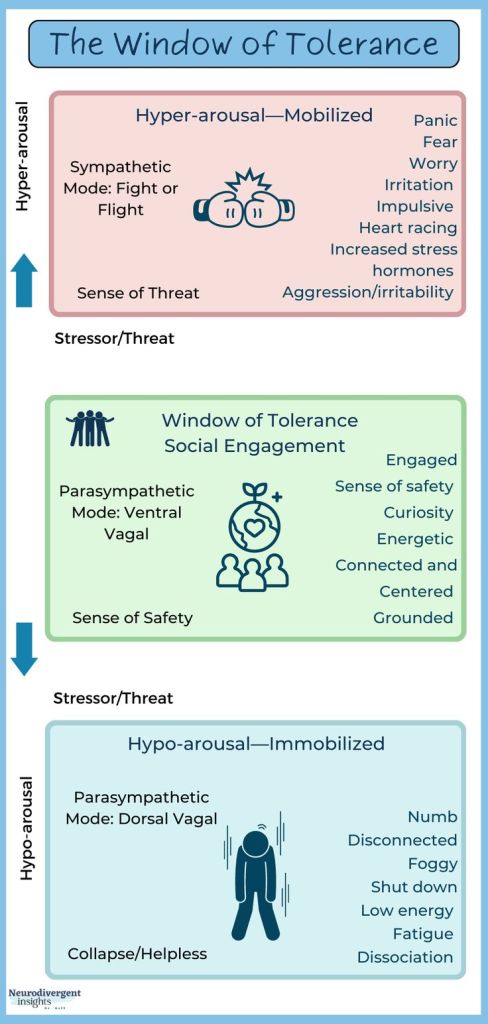
The Window of Tolerance
The window of tolerance refers to the range of nervous system activation where we feel grounded, present, and able to cope with daily life. When we’re within this window, we can think clearly, feel our emotions without being overwhelmed, and stay connected to ourselves and others.
Trauma can narrow this window, making it easier to tip into:
- Hyperarousal (above the window): anxiety, panic, irritability, racing thoughts, or feeling constantly “on edge”
- Hypoarousal (below the window): numbness, shutdown, dissociation, exhaustion, or feeling disconnected
Polyvagal-informed therapy focuses on gently expanding your window of tolerance so your nervous system has more flexibility and resilience.
Who Polyvagal-Informed Therapy Can Help
This approach can be especially helpful for people who:
- Feel emotionally overwhelmed or shut down without knowing why
- Struggle with chronic anxiety, panic, or emotional numbness
- Notice strong body-based trauma responses
- Want practical tools to feel safer and more regulated in daily life
What to Expect in Polyvagal-Informed Therapy
Sessions often include learning to notice your body’s signals, identifying what helps your system feel safe, and practicing regulation strategies that work with your nervous system rather than against it. This may involve breathwork, grounding, movement, imagery, or small shifts in awareness and pacing.
Polyvagal-informed therapy isn’t about forcing calm — it’s about building safety, choice, and self-trust. Over time, many clients experience greater emotional steadiness, improved connection, and a nervous system that feels less reactive and more at ease in the world.
Podcasts
Podcast Specific Episodes
Polyvagal Basics with Dr. Stephen Porges
Practical Applications for Polyvagal Theory with CPTSD
Practical Applications for Polyvagal Theory with Deb Dana
The Healing Power of the Vagus Nerve
Befriending Your Nervous System with Polyvagal Theory
Polyvagal Theory, Trauma, and Neuroscience of the Mind
Books
Anchored by Deb Dana
Polyvagal Exercises for Safety and Connections by Deb Dana
The Polyvagal Theory by Dr. Stephen Porges
The Nervous System Workbook by Deb Dana
Glimmers Journal by Deb Dana
 Healing Roots Trauma Therapy